Warrior’s code of honour
Heart of the HunterThe Warrior’s code of honour gives Thobela Mpayipheli a measure by which to judge both the way he fights and the man he might become. Inherited through his uncle Senzeni’s teaching, the code demands a face-to-face contest in which an opponent can see and answer the attack. Thobela’s experience exposes the limits of that ideal: a weapon and a direct encounter do not make violence honourable when the targets are not fighters. The code therefore becomes not a license for violence but a standard that condemns some of Thobela’s own actions and forces him to choose what kind of life he will lead.
Inheritance and Definition
The code takes shape in Thobela’s memory of Senzeni, who taught him about the history of the stabbing spear and challenged the version of that history he regarded as a European myth. At Grahamstown, Senzeni explained how long assegai shafts had been broken, producing the shorter weapon, and told Thobela that even his people’s history had been plundered. He also connected Thobela to the past through an image of inherited character: Thobela had the blood of Nqoma and the soul of Nxele, which he was told to give life. The lesson makes honour a responsibility to inherited history, not merely a personal preference about weapons.
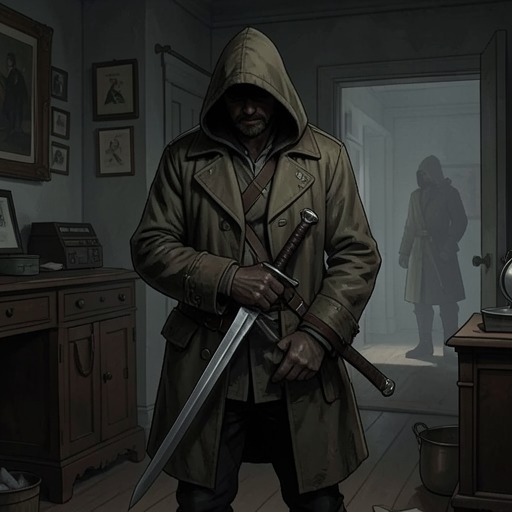
Years later, in Amsterdam, Thobela encounters an assegai among commercialized images of Africa and buys it. He cuts down its shaft in his hotel room, recalling Senzeni’s teaching as he prepares the weapon. He then lays the shortened spear at the feet of his masters in the East German Ministry for State Security and declares, in effect, that he will henceforth fight by looking his opponents in the eye and allowing them to answer. The masters accept the proposal with apparent amusement, but Thobela is undeterred. He makes a scabbard so the weapon can be carried against his body, keeping the code physically close as well as mentally present.
The principle is stated plainly in his insistence that “The enemy must see him. The enemy must be able to fight back.” Its emphasis is reciprocal: the opponent must be visible as a person and permitted to resist. Thobela’s code thus distinguishes combat from killing those who cannot meaningfully meet him in a fight. It also sets a demanding standard for his own conduct; a chosen weapon or a declared rule cannot, by itself, make an act honourable.
The Code Tested by Thobela’s Work
Thobela’s later reflection reveals the gap between the code he professes and the violence he has carried out. In Chicago, he waits for a young Czech diplomat and kills him with a blade. He sees the man as frightened and insignificant, not as a worthy opponent, and recognizes that the act has no honour. The victims of his past work, he reflects, were mostly pale, plump civil servants rather than fighters. Although he had treated them as participants in the Conflict, he comes to see that they did not meet the standard his code demanded.
That recognition turns the code against Thobela’s self-image. He had believed that direct confrontation and the assegai would make a difference; instead, he understands that pressing the blade on people who were not combatants betrayed what he was. His reflection links this failure to a larger inheritance: the people he killed had been someone’s fathers or sons, and the Cold War conflict that had helped give his work its meaning has passed. What remains, he realizes, is memory and consequence. The code cannot erase those consequences; it makes them harder to evade.
A later assassination sharpens the same judgment. When a bald man appears at a doorway, Thobela fires a long black weapon, then dismantles it and packs it away. The sequence takes forty-seven seconds. In that interval he understands that he cannot wage war in this manner and that there is no honour in it. His rule that the enemy must see and be able to fight back is not satisfied simply because he has adopted direct combat as an ideal. The scene marks a recognition of the distance between a warrior’s code and the methods of assassination he has used.
Honour Beyond Combat
Thobela’s explanation to Miriam Nzululwazi shows that honour also governs choices outside the battlefield. He acknowledges that he has said he can no longer live his former life and that he meant it. He agrees that he can refuse the new obligation before him: the decision is his, and he must choose what he considers right. Yet he also feels indebted to Johnny Kleintjes, describing that debt as a matter of honour. For him, honour includes the lawful, non-violent life of going to work and returning home to care for Miriam and Pakamile Nzululwazi, but it also requires him to pay what he owes.
That argument does not resolve the conflict between duty and the peaceful life Thobela has promised his family. Instead, it makes the cost of choice explicit. He cannot treat honour as a convenient excuse for returning to violence, because he recognizes that saying no is possible; nor can he reduce his obligations to the comfort of his household. His code asks him to weigh competing responsibilities and accept that the difficult choice is still his to make.
From Predator to Possibility
The code’s importance finally lies in its capacity for self-judgment. Thobela thinks of himself as a former predator, though even that description remains uncertain. Having looked at his life and found it abhorrent, he allows for the possibility that others might also change. The hope he imagines is deliberately small at first: one person, then two, then a handful, shifting the balance enough to begin reclaiming and rebuilding. His vision of a new life with Miriam and Pakamile at Cala is tentative, but it contrasts with the predatory existence he has come to reject.
The Warrior’s code of honour therefore changes in meaning as Thobela tests it. It begins as a rule for how a warrior should face an enemy, inherited through Senzeni and embodied in the assegai. It becomes an indictment when Thobela recognizes that some of his victims were not fighters, and a broader ethic when he weighs repayment against care and non-violence. The code does not guarantee redemption or settle his future; it supplies the terms on which he can recognize his betrayal, take responsibility for its consequences, and imagine that change might still be possible.